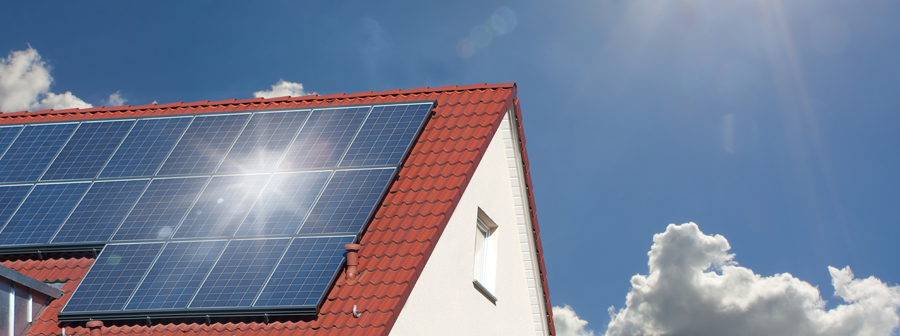
Photovoltaic panels in Belgium: near the end of the compensation scheme?
A number of changes have been brought in since 1 January 2020, causing great confusion among owners of photovoltaic panels. The end of the compensation scheme for the consumption/feed-in of self-produced energy is now effective in the Brussels Region . In parallel, the number of green certificates granted to prosumers is expected to fall. The same can be seen in Wallonia where the prosumer tariff came into force on 1 October 2020, despite an attempt by the Walloon government to postpone this measure until 2025. Flanders, meanwhile, is planning a gradual exit.
Until now, the compensation scheme had been one of the incentives implemented in Belgium to encourage households to fit photovoltaic panels. Under this system, the solar electricity fed into the network is deducted from the electricity bill, in terms of both electricity purchased and network usage costs.
However, the “Electricity market design” European Directive, adopted in June 2019, encourages Member States to abandon this compensation scheme by 2023. The objective is to ensure that all consumers contribute to the network costs equally, regardless of whether they have solar panels or not. This withdrawal from the compensation scheme began in Belgium in 2020. However, the measures vary from region to region. They often take the form of an “injection tax”, like the prosumer tariff in Wallonia.
Empty title
The end of the compensation scheme
Sibelga, the Brussels distribution network operator (DNO), has ended the principle of the “meter that runs backwards” (also called the compensation scheme) with effect from 1 January 2020. The Brussels Region is the first to implement this withdrawal.
Prosumers in the capital are already required to fit a dual meter. This facilitates the implementation of this new measure, as Brussels households can already see on their meters the actual quantities of electricity drawn from the network. The capital’s DNO, Sibelga, is reponsible for this transition to dual meters.
Discover all the energy suppliers promotions!
Compare electricity and gas prices and switch supplier for free in just a few clicks on Energyprice.be.
Since November 1st, for owners of small photovoltaic installations (less than 5 kWp), it is no longer only the distribution costs that are affected by the end of this compensation but also the energy part of the bill, otherwise called “commodity”.
What are then the direct consequences on the energy bill of households in Brussels?
- They will have to pay the energy costs as well as network costs for the entire amount of electricity consumed from the grid, regardless of the amount fed into it;
- Their excess production of electricity injected in the network will be purchased back following to the rates and conditions in the signed contract;
- Their instalments will be adapted accordingly.
A reduction in the number of green certificates
Since 2018, Brugel, the Brussels energy regulator, has wanted to reduce the number of green certificates granted to green energy producers. This decrease would not be retroactive and would only have an impact on new photovoltaic installations.
The Government of the Belgian capital had therefore announced that over the course of 2020, the number of green certificates allocated to new photovoltaic installations would be scaled back. This reduction of the number of green certificates finally started in January 2021.
As a reminder, a green certificate is “an intangible title that has a financial value only when it is sold” (source: CWaPE). For installations fitted previously, there will be no retroactive effect.
What will be the effects of this measure?
In practice, small installations of less than 6 kWc will receive 17 % fewer green certificates. Large installations will see a reduction of 13% to 42% in the number of green certificates received, depending on the size of the installation. Nevertheless, the promise remains the same: a return on investment within 7 years. Furthermore, this reduction in the number of green certificates granted can be attributed to the fall in the price of photovoltaic installations. According to Brugel, the cost of a 3 kWc installation fell from 8,100 euro in 2012 to 4,800 euro in 2018.
Moreover, this reduction in the number of green certificates granted is designed to prevent an economic bubble.
“If a scheme is too lucrative, there could be an explosion of roof installations, leading to a proliferation of green certificates. In the end, people would no longer be able to sell their green certificates as there would be too many on the market.”
Adeline Moerenhout, Brugel spokesperson
However, since 1 January 2022, the grant rate of green certificates has changed in the Brussels-Capital Region and now amounts to:
- 2.7 GC per MWh produced for installations less powerful than 5 kWp (kilowatt-peak);
- 2.5 GC per MWh produced for installations with power ranging from 5 to 36 kWp;
- 2.1 GC per MWh produced for installations with power between 36 and 100 kWp;
- 1.8 GC per MWh produced for installations whose power is comprised between 100 and 250 kWp;
- 1.5 GC per MWh produced for installations with power above 250 kWp.
Do you own a business with an energy consumption of more than 100,000 kWh?
Is your business paying too much for energy? Whether you run a small business or a large company, energy costs can eat into your profits. By comparing energy providers, you could lower your rates and save thousands each year.
Flanders: a gradual exit
The VREG, the Flemish energy market authority, established the prosumer tariff in Flanders at the end of 2014. However, change was in the air and with the end of backwards running meters in 2021, this tariff was eventually abolished.
For households that have installed photovoltaic panels before 2021, it is already possible to install a smart meter. This installation is available on request or as part of a meter replacement programme scheduled by the DNO. The owners of solar panels equipped with such a meter pay as a result for the energy they actually use. The prosumers will receive a compensation for the energy they feed into the network.
Note that househoulds equipped with an analog meter can still enjoy the system of the meter running backwards. This is, however, a temporary situation as Fluvius, Flanders’ DNO, is planning on remplacing all meters in the coming years.
Finally, know that you can choose to make the switch at any time. However, please note that it is irreversible. This decision will be beneficial if:
- you are often at home during the day;
- you self-consume the electricity that is produced.
Empty title
In September 2019, the new Government in Wallonia wanted to postpone the “prosumer tariff” until 2025, in other words, a 5-year delay from the initial date (1 January 2020). Nevertheless, the CWaPE, which is the body responsible for setting energy prices in Wallonia, confirmed that this would not be the case. Both parties got entangled in political confrontations until May 1st 2020, the agreed deadline to find a suitable compromise.
On the eve of that deadline, at the eleventh hour, the Government published an agreement stating that it would be implementing various “accompanying measures”. For their part, the CWaPE has agreed to to further postpone the fee until 1 October 2020. Today, the prosumer tariff has eventually come into force.
Compare now all energy suppliers active in Belgium and save money on your bill !
What are the accompanying measures for this added cost?
In order to compensate for the added 450 € for the Walloon prosumers, the Government voted for the following support measures:
- A compensation premium which will reimburse 54.7 % of the prosumer tariff in 2022 and 2023;
- Aid for the installation of a smart meter: the Government will grant a two-way meter for free to the prosumers who request it, as well as a 155 € premium excl. VAT for its installation.
- A home automation premium: households (prosumers or not) will also be able to request a home automation premium (up to 400 €) in order to install measurement and control equipment. They will therefore be in a position to maximise their self-comsumption of electricity.
- The possibility of requesting a backwards running meter: households which install solar panels before 31 December 2023 will still have the option to choose a meter running backwards if they so desire.
Why a prosumer tariff?
The Distribution Network Operators (DNO) plan on gradually replacing all analog meters with smart ones between 2023 and 2029. That way, when prosumers will be equipped with it, they will be charged according to the amount of electricity they actually draw from the network. The compensation scheme should then progressively disappear.
Empty title
Faced with these new regulations, it is important to review how you consume electricity. To keep control over your electricity bill, make sure you draw as little electricity as possible from the network. To do this:
- Reduce your excess consumption as much as possible
- Schedule your energy-hungry appliances (dishwasher, tumble dryer, etc.) to run during the day
- Invest in a home battery
- Use LED lightbulbs
Which energy supplier suits you best? Find it out with a simulation!

Summary
Also read on our blog
How can you estimate your gas consumption or calculate it precisely? It’s simple – read your meter carefully and analyze the right…
Summary What is a gas connection? How do you connect your home to the gas network? Submitting a request for a gas connection Carry…

Are you a tenant? If so, you should probably pay attention to some aspects of your energy contracts. Who is responsible for what b…